
WPPI Energy Contract Extension
Overview
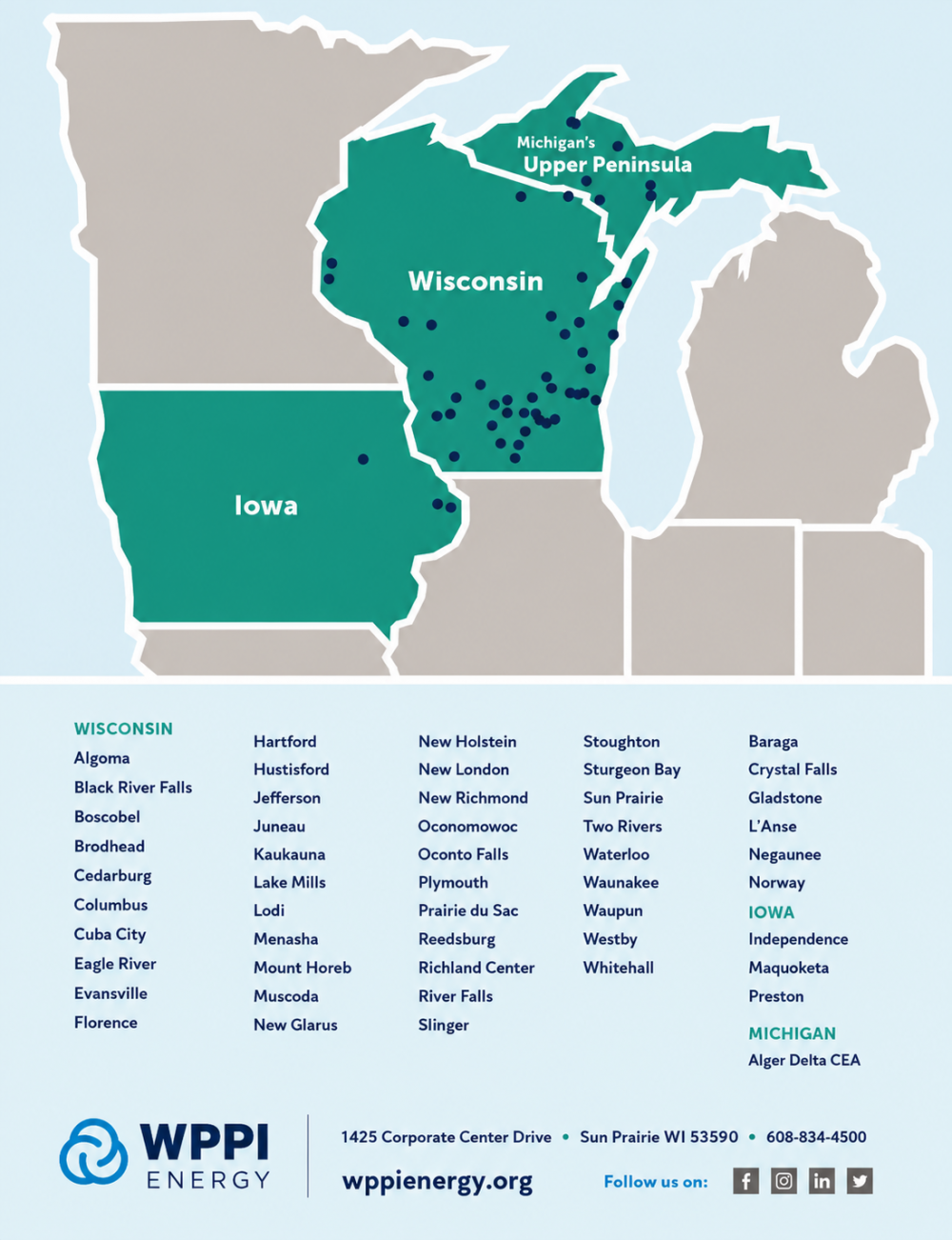
The Two Rivers Electric Utility has been a member of WPPI Energy for more than 45 years. WPPI Energy is a regional, not-for-profit wholesale power provider owned and governed by locally owned municipal electric utilities. Today, WPPI serves 51 municipal utilities across Wisconsin, Iowa, and Michigan, providing wholesale electricity, long-term resource planning, engineering, market operations, and other utility support services.
Unlike investor-owned utilities, such as Wisconsin Public Service (WPS), WPPI does not provide electric service directly to homes and businesses. Instead, WPPI supplies wholesale power to member municipal utilities like Two Rivers, which then own, operate, and maintain their local electric distribution systems while providing retail electric service to customers.
The City of Two Rivers has received its wholesale electric power from WPPI under a long-term membership agreement since the organization was established. That agreement has been extended twice previously (in 2002 and again in 2015) and currently runs through December 31, 2055.
WPPI is now asking its member communities to consider an 18-year extension of that agreement, moving the contract expiration from 2055 to 2073. The purpose of the extension is to provide the long-term certainty needed to finance and develop the generation, transmission, and other infrastructure investments necessary to reliably serve member utilities for decades to come.
It is important to understand that this is not a contract to purchase today's electricity through 2073. Rather, it is a long-term membership agreement that allows WPPI to continue acquiring, financing, replacing, and managing the power resources that will serve member communities over time. As technologies change and older generation assets retire, WPPI's power supply portfolio will continue to evolve, just as it has throughout the organization's history.
The Two Rivers City Council has not taken this decision lightly. Since June 2026, Council members have received presentations from WPPI leadership, multiple Council Briefs, public meeting discussions, and supporting materials explaining the proposed extension. This webpage has been created to consolidate those materials and answer many of the questions that have been raised throughout the review process.
1. What is the City considering?
The City is considering whether to extend its wholesale electric power supply agreement with WPPI Energy from 2055 to 2073.
This decision does not change who provides electricity today. Two Rivers will continue receiving electricity from WPPI through 2055 under the existing contract. The question is whether the City wants to preserve its guaranteed opportunity to continue that relationship beyond 2055 while that opportunity is available.
2. Why is this decision being made almost 30 years before the current contract expires?
Electric generation and transmission infrastructure are among the most expensive investments any utility makes. These projects often take decades to plan, finance, construct, and pay off.
Long-term contracts allow organizations like WPPI to borrow money over longer periods, lowering financing costs and providing greater certainty when planning major investments.
A helpful analogy is refinancing a mortgage. Most homeowners don't wait until their mortgage expires before arranging future financing. Instead, they secure favorable terms while they are available.
3. Does Two Rivers have to decide now?
No, but the current opportunity will not remain available indefinitely. WPPI's offer to extend contracts to its 51 members is available only during a defined extension period. If Two Rivers declines, there is no contractual guarantee another opportunity will be offered later.
Future participation would depend entirely on whether a future WPPI Board decides to offer another extension and that would likely come with a high cost to buy back in, which in turn would result in higher electricity rates.
4. What happens if the City decides not to extend?
The current contract would remain in effect through 2055. However, declining the extension today means:
- The City gives up its guaranteed right to continue purchasing power from WPPI after 2055.
- WPPI must begin planning as though Two Rivers' future electric load may leave the system.
- Future borrowing and long-term planning become more complicated.
- Financing costs for future infrastructure projects could increase.
In other words, declining today doesn't simply delay the decision but it begins affecting long-term planning immediately.
5. Is this just about one power plant?
No. The extension supports financing for an entire portfolio of long-lived infrastructure, including:
- New electric generation resources
- High-voltage transmission projects
- Regional electric grid improvements
- Future transmission investments through American Transmission Company (ATC)
- Ongoing refinancing of long-term electric infrastructure
The contract provides financial certainty that allows these investments to be financed at lower borrowing costs.
6. What projects is WPPI investing in?
Recent and planned investments include:
- Approximately $100 million for WPPI's share of a new natural gas combustion turbine expected to come online in late 2027.
- Approximately $28 million for transmission infrastructure associated with the Grid Forward Project and other regional transmission improvements.
- Approximately $54 million in bonds issued to fund 2026–2027 American Transmission Company (ATC) capital investments, with additional investments anticipated in future years.
These projects are intended to improve long-term electric reliability and strengthen the regional power grid serving communities like Two Rivers.
7. Does WPPI provide more than wholesale electricity?
Yes. WPPI provides a variety of shared services that support the City's electric utility, including:
- Rate studies
- Utility billing support
- Meter data management
- Joint purchasing
- Information technology assistance
- Customer information systems
- Economic development assistance
- Energy efficiency programs
- Technical training
- Key account management
If Two Rivers were ever to leave WPPI, the City would need to replace these services independently by adding additional City staff or paying outside consultants.
8. Will this affect my electric bill?
The contract itself does not immediately change electric rates.
However, one reason for extending the contract is to help finance major infrastructure projects at lower borrowing costs. Lower financing costs help reduce long-term wholesale power costs compared to financing similar projects over shorter periods.
The City has also noted that Two Rivers' residential electric rates remain among the lowest in the region and approximately 21% below the Wisconsin average, according to Public Service Commission comparisons. Manitowoc is slightly lower because they supplment their electric supply with their own power plant.
9. Has the City discussed this publicly?
Yes. Before any Council vote, the proposal was discussed over several weeks through:
- A 40-minute public presentation by WPPI's President and CEO.
- Public question-and-answer sessions.
- Council Utility Committee discussions.
The City has continued providing information as Council evaluates the proposal.
10. Has another community faced this situation?
Yes. The example of Preston, Iowa, provides a cautionary tale for Two Rivers. That small rural community chose not to extend its contract during an earlier WPPI extension period over ten years ago. Because its contract expires earlier than other WPPI members, Preston is not part of the current extension offer and they now have no wholesale power supply secured once their current contract expires.
This is a good example to illustrate that future extension opportunities are not guaranteed.
11. Why does the City Staff recommend approval?
The professional analysis concludes that extending the contract:
- Preserves the City's guaranteed opportunity to continue purchasing power after 2055.
- Helps keep financing costs lower for future infrastructure.
- Supports continued access to regional generation and transmission resources.
- Maintains access to the operational support services provided through WPPI.
- Provides long-term planning certainty for the City's electric utility.
The recommendation is based on preserving future options and maintaining financial stability rather than making a decision about how electricity will be generated decades from now.
12. How are electric utility rates set in Wisconsin?
Municipal electric utilities like Two Rivers do not simply choose electric rates at will. Rates are based on the actual cost of providing electric service and are intended to recover the utility's operating expenses, wholesale power costs, maintenance, and necessary investments in the electric system.
Unlike investor-owned utilities, municipal electric utilities like WPPI are owned by the communities they serve and operate on a not-for-profit basis. Any revenues collected remain within the utility to maintain and improve the electric system rather than being distributed to outside shareholders.
Before changing rates, utilities typically complete a professional cost-of-service and rate study. These studies evaluate:
- The cost of purchasing wholesale electricity.
- Operation and maintenance expenses.
- Investments in poles, wires, substations, and other infrastructure.
- Debt repayment.
- Future capital improvements.
- Fair allocation of costs among residential, commercial, and industrial customers.
The goal is to ensure each customer pays a fair share of the actual cost of providing electric service.
Two Rivers also compares its electric rates against other Wisconsin utilities. According to recent Public Service Commission comparisons, Two Rivers' residential electric rates remain among the lowest in the region and approximately 21% below the Wisconsin average.
Ultimately, the City Council approves electric rate changes after reviewing the utility's financial condition and recommendations from utility staff and professional rate consultants.
13. Is there a limit on how much electricity a large data center or technology company can purchase from a local utility?
There is no set cap on how much electricity a large technology customer can purchase from a local utility. However, there are practical limitations, particularly the amount of available generation and transmission capacity needed to serve a very large electric load.
For WPPI member communities like Two Rivers, the local City utility can structure how a large new load is served, subject to applicable regulatory approvals. WPPI has experience serving individual industrial loads of about 20 MW, which is nearly equivalent to Two Rivers' entire current peak electric demand. For loads significantly larger than that, additional generation, capacity arrangements or interruptible service could be required.
Most importantly, WPPI's approach would be to isolate the financial risks associated with serving a very large new customer, rather than shifting those risks and costs to existing member utilities and their customers. At the same time, WPPI would look for opportunities where adding a large customer could provide benefits that help lower costs for the broader membership.
14. Is there a possibility that the former Kewaunee Nuclear Power Plant could reopen?
Current discussions surrounding the Kewaunee nuclear site are focused on the potential development of new nuclear generation, rather than restarting the former nuclear plant. Even if a new nuclear project ultimately moves forward at the site, 10–12 years would likely be the earliest timeframe in which a new plant could be licensed and constructed.
This is another example of the very long planning horizons involved in developing major electric generation resources.
15. Does WEC Energy Group's new Point Beach agreement affect WPPI's nuclear power supply?
No. WEC Energy Group has reached a new long-term agreement with NextEra Energy for power from the Point Beach Nuclear Plant. That agreement is subject to approval by the Wisconsin Public Service Commission. Importantly, WEC's agreement does not change WPPI's earlier Point Beach agreement from 2025. WPPI previously secured approximately 168 MW of Point Beach generation, with its purchases extending through 2050 for Unit 1 and 2053 for Unit 2. Learn more about WPPI's Point Beach agreement
16. Will WPPI rely more heavily on coal and natural gas in the future?
WPPI's future strategy is better described as diversification rather than greater reliance on any single fuel source.
Coal appears to be headed in the opposite direction, with three baseload units in which WPPI has ownership interests expected to transition away from coal by 2035. Natural gas, however, is expected to remain important because it provides reliable, dispatchable generation when resources such as wind and solar are not producing enough electricity.
WPPI's long-range planning anticipates a changing mix that could include additional renewable generation, natural gas, battery storage and other technologies as they become economically and operationally viable. Nuclear will also remain an important part of the portfolio, with WPPI's Point Beach agreement extending into the early 2050s.
Extending the City's WPPI agreement to 2073 does not lock Two Rivers into today's generation mix. The resources WPPI uses to serve its members have changed considerably over time and will continue to evolve as technology, economics and energy markets change.

Contact Information
Customer Service (City Hall)
1717 East Park Street
Two Rivers, WI 54241
Phone: 920-793-5523
Email: customerservice@two-rivers.org
Customer Service Hours
Mon - Thurs: 7:30 am - 5:00 pm
Friday: 7:30 am - 11:30 am
Closed: Saturday & Sunday
Electric & Water Operations Office
1415 Lake Street
Two Rivers, WI 54241


